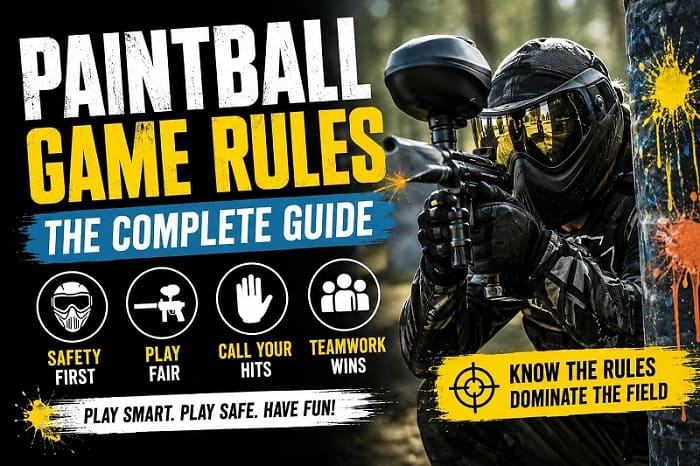

Paintball Game Rules: Everything You Need to Know Before You Play
Paintball is one of the most exciting outdoor sports, combining teamwork, strategy, communication, and fast-paced action. Whether you’re playing for fun with friends or competing in tournaments, understanding the rules of paintball is essential for safety and fair play.
This comprehensive guide explains the basic and advanced paintball game rules, safety requirements, common game modes, penalties, and tips that every player should know before stepping onto the field.
What Is Paintball?
Paintball is a recreational and competitive sport where players eliminate opponents by shooting biodegradable paint-filled capsules (paintballs) from compressed air-powered paintball markers (commonly called paintball guns).
The objective varies depending on the game mode but usually involves:
- Eliminating the opposing team
- Capturing a flag
- Defending an objective
- Completing a mission
- Surviving until time expires
Paintball emphasizes strategy more than strength, making it suitable for players of different ages and fitness levels.
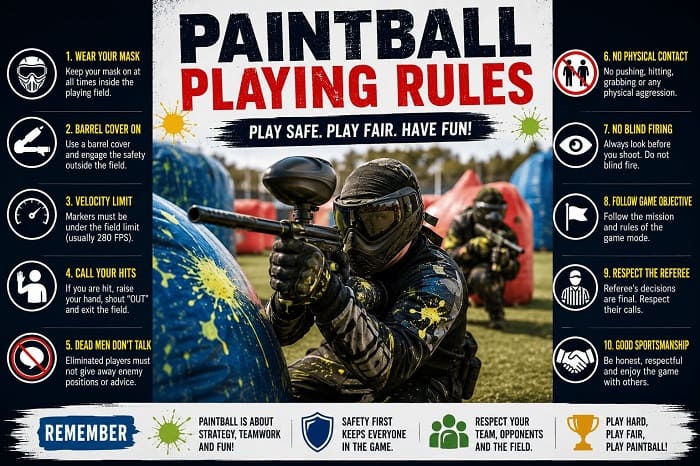
Basic Paintball Rules
Although different fields may have their own specific rules, these are considered universal.
1. Always Wear Your Safety Mask
This is the most important rule in paintball.
Players must keep their approved paintball mask on at all times while inside the playing field or any area where markers may be fired.
Never remove your mask until instructed by the referee.
Eye injuries can occur instantly if masks are removed during play.
2. Barrel Cover Is Required Outside the Field
Whenever you leave the playing area:
- Install the barrel sock or barrel cover.
- Engage the safety.
- Keep your marker pointed toward the ground.
This prevents accidental firing.
3. Marker Velocity Limit
Paintball markers are usually limited to:
Maximum: 280 feet per second (FPS)
Some fields allow:
- 285 FPS
- 300 FPS (less common)
Before every game, referees chronograph each marker to ensure it meets safety standards.
4. Elimination Rule
A player is eliminated when:
- A paintball hits them
- The paintball breaks
- Leaves a paint mark roughly the size specified by the field (usually larger than a quarter)
Examples of valid eliminations:
- Head
- Mask
- Body
- Arms
- Legs
- Backpack
- Pod pack
- Marker (field dependent)
Examples that usually do NOT count:
- Paintball bounces without breaking
- Splatter from another nearby hit (depends on field rules)
- Ground splash
Always ask the referee if uncertain.
5. Call Yourself Out
Honesty is one of paintball’s core principles.
If you’re hit:
- Raise your marker.
- Raise one hand.
- Shout:
“OUT!”
Leave the field immediately using the designated exit path.
Do not continue shooting.
6. Dead Men Don’t Talk
Once eliminated:
- Do not communicate enemy positions.
- Do not coach teammates.
- Do not reveal hidden opponents.
- Exit quietly.
Giving tactical information after elimination is considered cheating.
Safety Rules
Safety always comes before winning.
Never Shoot at Close Range
Many fields enforce a surrender rule.
If you are extremely close to an unaware opponent:
Instead of shooting,
Say:
“Surrender!”
The opponent may choose to surrender without being shot.
Some fields make this mandatory.
No Blind Firing
Players must always:
- Look where they shoot.
- Keep eyes behind the marker.
Do not stick your marker around corners without looking.
Blind firing is unsafe and usually prohibited.
No Physical Contact
Paintball is not a contact sport.
Players may not:
- Punch
- Kick
- Push
- Grab
- Wrestle
- Tackle
Physical aggression leads to immediate removal.
No Climbing Dangerous Structures
Players should not climb:
- Roofs
- Unsafe bunkers
- Trees
- Field boundaries
Stay within designated playing areas.
Common Paintball Game Modes
Elimination
Objective:
Eliminate every player on the opposing team.
The last team with active players wins.
Capture the Flag
Each team protects its own flag.
Players attempt to:
- Capture the enemy flag.
- Return it safely to their base.
The first successful capture wins.
Center Flag
One flag is placed in the middle of the field.
Teams race to:
- Capture it.
- Return it to their base.
Attack and Defend
One team attacks.
The other team defends a bunker, building, or objective.
The attackers must complete the mission before time expires.
King of the Hill
Teams fight to control a specific location.
Whoever controls the objective longest wins.
VIP Escort
One team escorts a VIP safely across the field.
The opposing team tries to eliminate the VIP.
Scenario Games
Large scenario games often involve:
- Hundreds of players
- Military-style objectives
- Vehicles
- Props
- Multiple missions
- Several hours of gameplay
Tournament Rules
Competitive paintball follows stricter regulations.
Common tournament rules include:
- Team sizes (3-man, 5-man, 10-man)
- Time limits
- Mercy rule
- Penalties
- Official referees
- Paint checks
- Chronograph testing
Speedball tournaments often use inflatable bunkers and standardized field layouts.
Respawn Rules
Depending on the game:
No Respawn
Most elimination games.
Once eliminated:
You stay out.
Timed Respawn
Players return after:
- 1 minute
- 2 minutes
- 5 minutes
depending on the scenario.
Unlimited Respawn
Popular during recreational games.
Players continuously return from designated spawn points.
Overshooting Rules
Overshooting means firing excessive paintballs at an already eliminated player.
Example:
A player is already out.
Another player shoots 15 more paintballs.
This is poor sportsmanship and often penalized.
One or two confirming shots are generally acceptable.
Bonus Balling
Bonus balling occurs when players intentionally continue shooting an opponent after elimination.
This behavior is discouraged and may result in:
- Warnings
- Penalties
- Removal from the game
Wiping Paint
One of the biggest forms of cheating.
Wiping means:
Removing paint after being hit so referees cannot see it.
This usually results in:
- Immediate elimination
- Team penalties
- Possible expulsion
Paint Checking
If unsure whether a player is hit:
Call:
“Paint Check!”
A referee inspects the player.
Only referees determine whether a player is out.
Surrender Rule
Many recreational fields require surrender at very close distances (typically under 10–20 feet).
Players may say:
“Surrender!”
The opponent may:
- Accept and leave the game.
- Refuse and risk being shot.
Policies vary by field.
Blind Man Rule
If a player loses their mask:
They should immediately shout:
“Blind Man!”
Everyone must stop shooting until the situation is safe.
This emergency rule helps prevent serious eye injuries.
Referee Authority
The referee’s decisions are final.
Referees can:
- Eliminate players
- Call penalties
- End games
- Check equipment
- Stop unsafe behavior
Arguing with referees rarely changes the outcome and may result in removal from the event.
Good Sportsmanship
Paintball is built on respect.
Always:
- Call your hits honestly.
- Respect referees.
- Help new players.
- Avoid arguing.
- Congratulate opponents.
- Keep games enjoyable for everyone.
Good sportsmanship makes every match more enjoyable and encourages players to return.
Tips for Beginners
If you’re new to paintball, these tips can help you enjoy your first games:
- Keep your mask on at all times in active areas.
- Communicate with your teammates instead of playing alone.
- Move from cover to cover rather than standing in the open.
- Shoot only when you have a clear target.
- Carry enough paintballs but avoid unnecessary spraying.
- Stay aware of your surroundings and listen for referee instructions.
- Drink water and take breaks between games, especially in hot weather.
- Most importantly, focus on learning and having fun rather than just winning.
Frequently Asked Questions
Can paintball hurt?
Yes, being hit by a paintball can sting and may leave temporary bruises, but with proper protective equipment and adherence to field safety rules, the risk of serious injury is low.
Do paintballs always break?
No. Sometimes a paintball may bounce off a player without breaking. In most games, a hit only counts if the paintball breaks and leaves a visible paint mark.
Can I use my own paintball marker?
Many paintball fields allow players to bring their own markers, provided they pass a safety inspection and meet the field’s velocity limits. Some locations also require players to use field-approved paintballs.
Is camouflage clothing required?
No. Comfortable clothing that covers your arms and legs is usually sufficient. Many players wear padded paintball jerseys and pants for extra protection and mobility.
How long does a paintball game last?
Game lengths vary by format. Recreational matches often last 10–20 minutes, while large scenario games can continue for several hours with multiple missions.
Final Thoughts
Understanding paintball game rules is the first step toward becoming a safer, smarter, and more effective player. Whether you’re enjoying a casual weekend game or preparing for competitive tournaments, following the rules ensures fair play, protects everyone on the field, and makes the experience more enjoyable.
Before every match, take a few minutes to review the specific rules at your chosen paintball field, as policies regarding marker velocity, surrender distances, respawns, and game objectives can vary. By respecting referees, playing honestly, and prioritizing safety, you’ll help create an exciting and welcoming environment for players of all skill levels.